

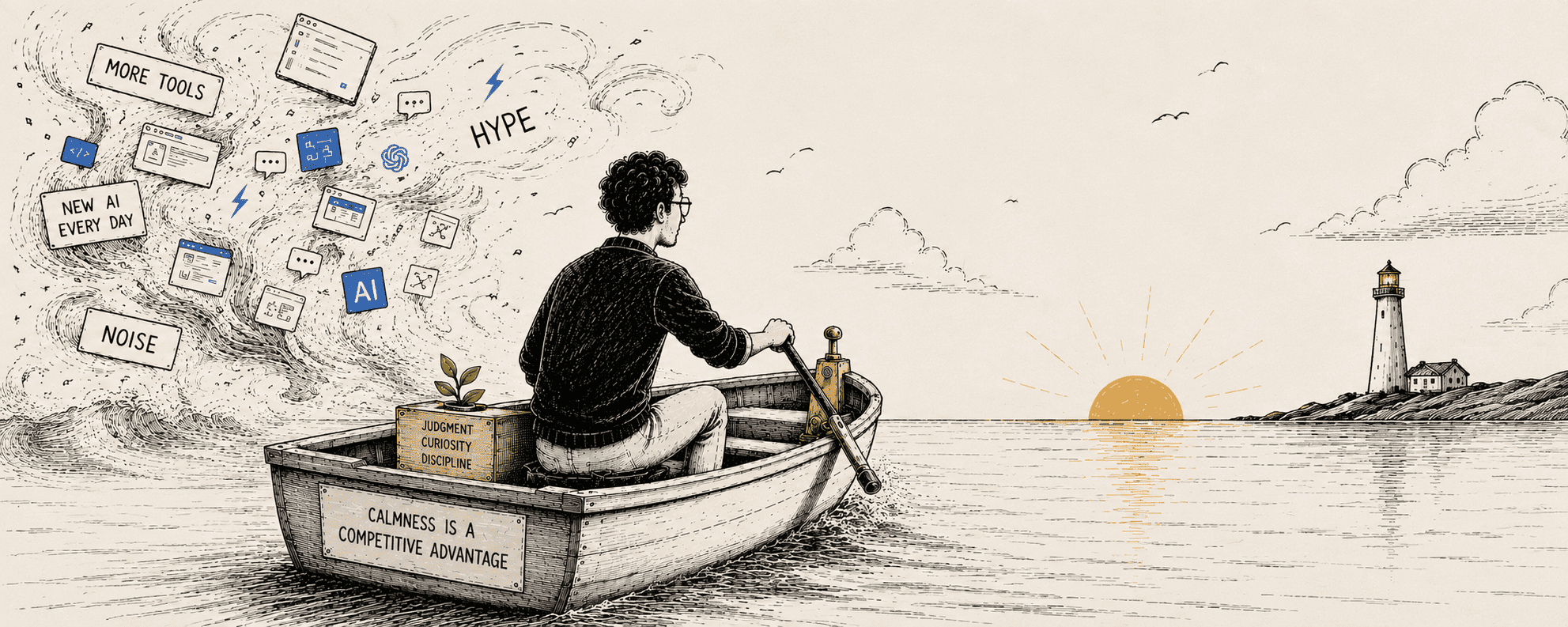
A personal philosophy for staying useful when tools, roles, and confidence are shifting faster.
In the same week, I had two conversations that felt oddly connected.
One was with a young designer trying to enter the field. She was anxious because every week someone online declares that AI has killed design. She was not lazy. She was not looking for a shortcut. She wanted to learn the craft properly. But the noise around her kept turning that desire into doubt.
Why learn something that AI can already generate?
The other conversation was with a designer who had spent close to a decade in the industry. His fear had a different shape, but it was not smaller. He was not asking whether he should begin. He was asking whether the game he had spent years learning had changed overnight.
That is the strange thing about this moment.
Beginners feel late before they start. Experienced people feel outdated before they can respond.
Different career stages. Same confusion.
The industry is moving faster than people can emotionally process. Every week there is a new tool, a new demo, a new thread, a new claim that some role is finished. People use a product for ten minutes and write like they have understood the next ten years.
Everyone wants to sound early. Everyone wants to sound certain. Most of that certainty is borrowed.
I don’t think the real problem is AI. The real problem is the paranoia around it.
AI paranoia makes beginners freeze before they begin. It makes experienced people protect old identities instead of building new range. It makes everyone chase tools without asking what is actually changing.
Paranoia is not a strategy.
A useful strategy asks calmer questions:
What is becoming cheaper? What is becoming more valuable?
What should I stop protecting? What should I start learning?
What part of my work was only execution? What part was judgment?
These are better questions than “Will AI replace me?” That question is too vague to be useful. It creates fear, not movement.
The better question is this:
What kind of person stays useful when the tools, roles, and rules keep changing?
That is the question I care about.
In midst of chaos, can you be courageous enough to be calm?
This is a quote from one of A. R. Rahman’s interview that I keep coming back to.
That feels like a career skill now.
Chaos is no longer occasional. It is the environment. New tools will keep coming. New processes will keep forming. New roles will keep appearing. New claims will keep flooding your feed.
If you react to all of it, you will become mentally poor even if you are technically updated.
Stillness is how you protect your attention. And attention is where good work begins.
Stillness does not mean avoiding change. It does not mean being slow, passive, or nostalgic. It means you don’t let the timeline decide your nervous system.
Notice the signal, ignore the theatre, and return to the work.
That is harder than it sounds because the internet rewards reaction. It rewards the first take, the loud take, the dramatic take. But good work rarely comes from that state.
Good work needs some quiet. Not silence from the world. Silence inside your own head.
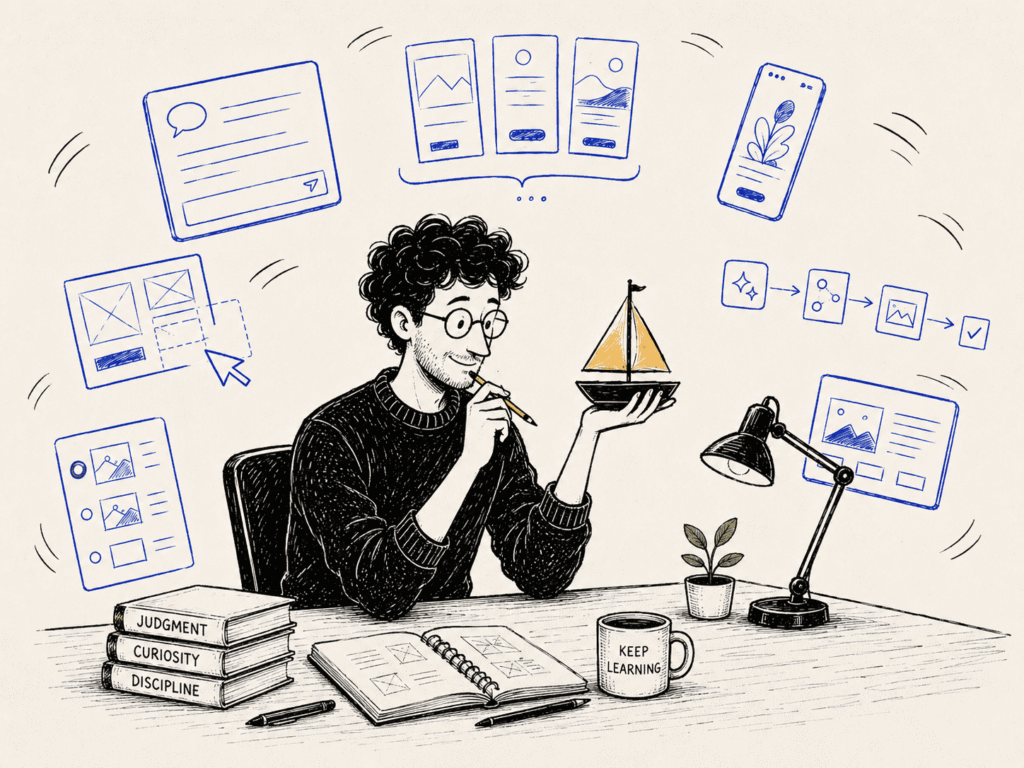
You thought AI threatened design. It actually threatened design tools.
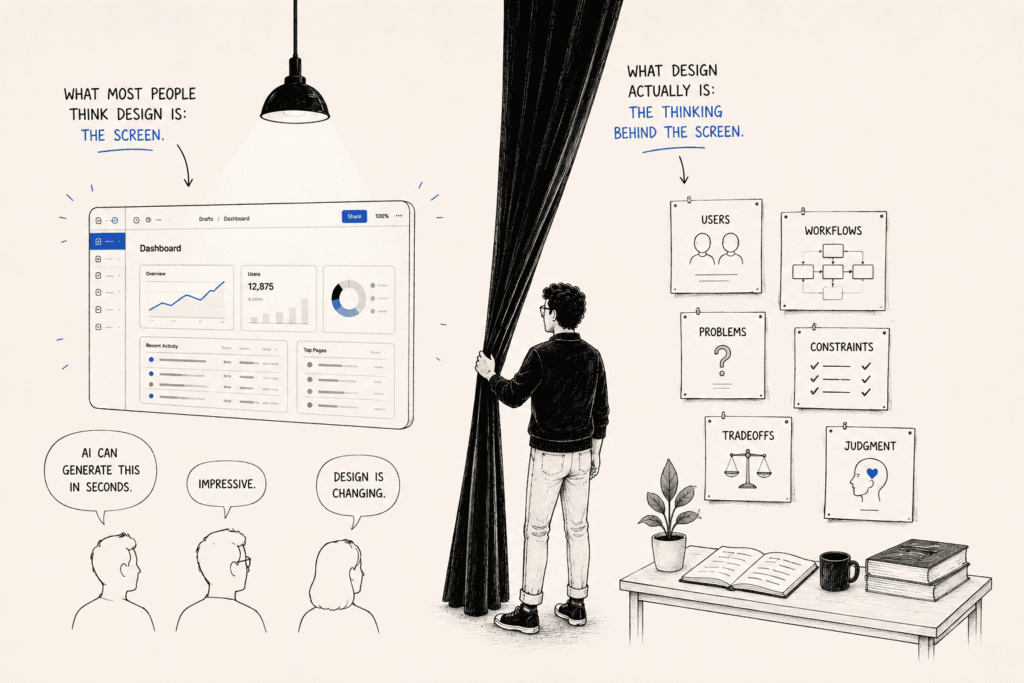
A lot of the fear comes from a simple mistake: people confused design with the tool used to produce design.
For years, Figma became the visible surface of the designer’s work. So when AI started generating screens, people assumed design itself was under attack.
But design was never Figma.
Figma is where some design decisions become visible. It is not the source of those decisions.
The real work happens before the screen. Who is this for? What problem are we solving? What should we remove? What does the user already understand? Where will they get confused? What does quality look like here? What tradeoff are we making?
AI can generate a hundred interfaces. That is useful. But it does not automatically know which one is right, which one is shallow, which one violates user behaviour, which one sounds wrong for the customer, or which one will quietly create friction in a real workflow.
That is judgment. And judgment is not produced by a tool. It is built through exposure, mistakes, feedback, taste, and time with real people.
I saw this in a small naming decision recently.
We were discussing a feature called recurring projects. Someone suggested using the word “repeat” instead. AI also supported it. On the surface, “repeat” sounded simpler. Cleaner. More obvious.
But our users are accountants. For them, “recurring” is not jargon. It is everyday language. Recurring invoices. Recurring work. Recurring billing. Recurring tasks. That word already exists in their mental model.
A generic AI suggestion may prefer the simpler word. A designer who knows the user may choose the more precise one.
That is the difference.
AI reads patterns from the internet. Designers absorb patterns from humans. Those are not the same thing.
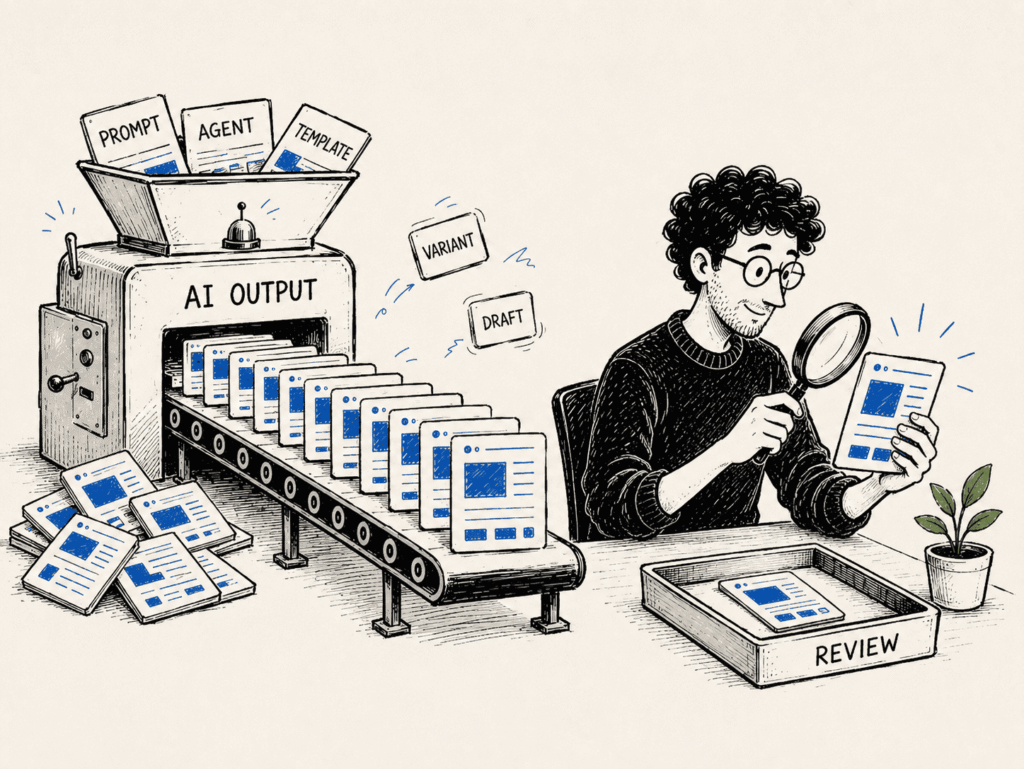
Average is becoming cheap. Judgment is becoming expensive.
AI is not making everyone excellent. It is making average work faster.
That sounds small, but it changes everything.
Earlier, mediocre execution still took effort. A person had to spend time making the screen, writing the copy, preparing the deck, or building the prototype. That effort created an illusion of value.
Now the effort is compressed. A screen appears in seconds. A landing page appears in minutes. A prototype appears before you finish your coffee.
This raises the floor. More things will look acceptable. More people will be able to produce passable output. More work will appear polished at first glance.
But when average becomes easy, average also becomes invisible.
The edge moves somewhere else. It moves to taste, restraint, and knowing what to remove. It moves to knowing when the generated answer is technically correct but contextually wrong. It moves to noticing that the colour is distracting, the hierarchy is weak, the copy is trying too hard, the interaction is clever but unnecessary, or the screen looks good in isolation but fails inside the workflow.
This is why I don’t believe the future belongs to people who can generate the most.
Generation is becoming cheap. Judgment is becoming expensive.
Job titles are blurring. Broader capabilities are now required.
For a long time, product teams were divided into neat roles. Product managers decided what should be built. Designers shaped how it should work and feel. Engineers built it.
That structure made sense when execution was expensive and specialised knowledge was harder to access. The handoffs were slow, but they protected quality. Each person owned a lane.
AI is now making those lanes more porous.
A designer can understand code faster. An engineer can prototype interfaces faster. A product manager can test flows faster. A founder can move from idea to demo faster.
This does not mean everyone becomes everything. That is another lazy extreme.
A designer will not magically become a deep backend engineer overnight. An engineer will not automatically become a great storyteller. A product manager will not automatically develop taste because a tool can generate screens.
But the strongest people will become less fragile across boundaries. They will not say “that is not my job” too quickly. They will say, “I don’t know this yet, but I can learn enough to move.”
That sentence is becoming a career advantage.
The industry is slowly moving from fixed titles to broader capabilities: builders, reviewers, and sellers.
Builders take problems from ambiguity to working form. They research, prototype, design, write, code, and ship enough to move the idea forward.
Reviewers protect quality. They ask whether the thing is correct, usable, safe, coherent, scalable, and worth shipping.
Sellers create belief. They understand positioning, distribution, narrative, trust, and why someone should care.
Most people will still have a home base. That is good. Depth matters. But the person with depth and range will be harder to replace than the person with depth and fear.
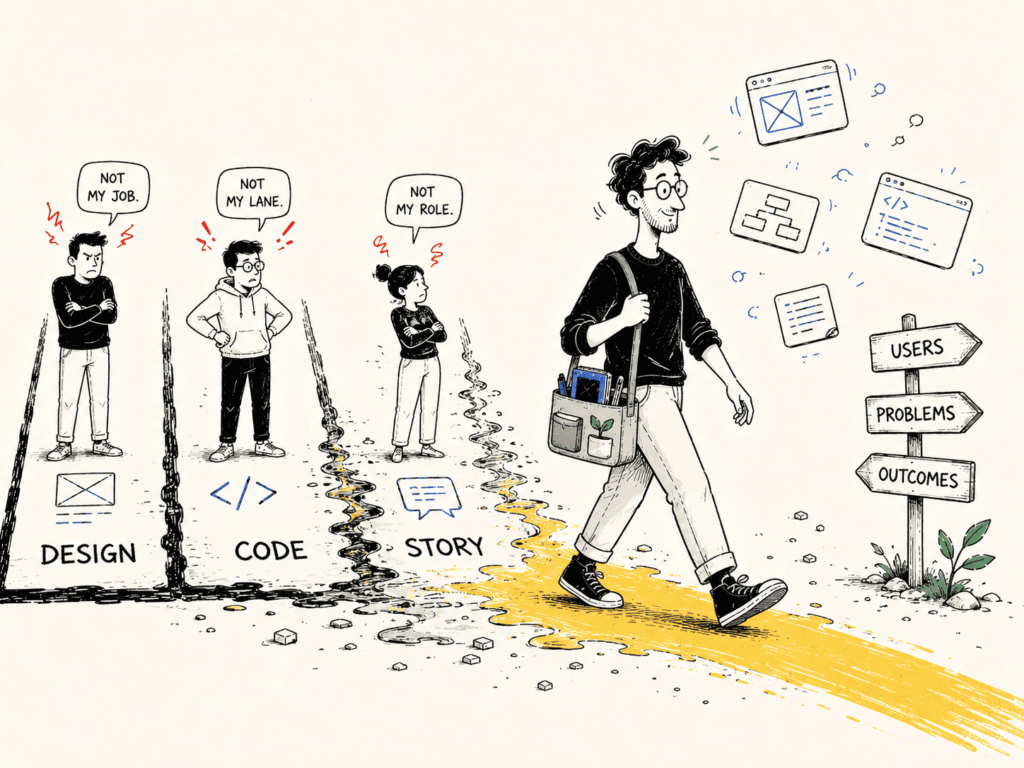
I felt this shift myself
For nearly ten years, I stayed mostly inside design tools: Figma, docs, reviews, handoffs, product discussions, design systems, prototypes.
Code was something I respected, but did not touch deeply.
That has changed.
Recently, I started opening codebases more often. Not to pretend I am suddenly an engineer. Not to bypass the people who know engineering better than me. I wanted to reduce dependency and understand the system more directly.
There was a feature in our product where one selection on the first screen changed what appeared on the next screen. Earlier, I would have asked an engineer to explain the logic. That would mean finding time, scheduling a discussion, asking them to inspect code written by someone else, and waiting for the explanation.
Now I open the codebase in Cursor and ask:
Explain this logic to me like I am a designer. I am designing variants of this flow, and I need to understand what changes based on what.
In a few minutes, I get enough clarity to move. Not perfect clarity. Enough clarity.
That distinction matters.
AI did not make me an engineer. It made me less blocked. It made me less afraid. It helped me participate closer to the actual material of the product.
That is the shift I care about. Not “AI replaced the designer.” More like: the designer who learns how systems work becomes more useful.
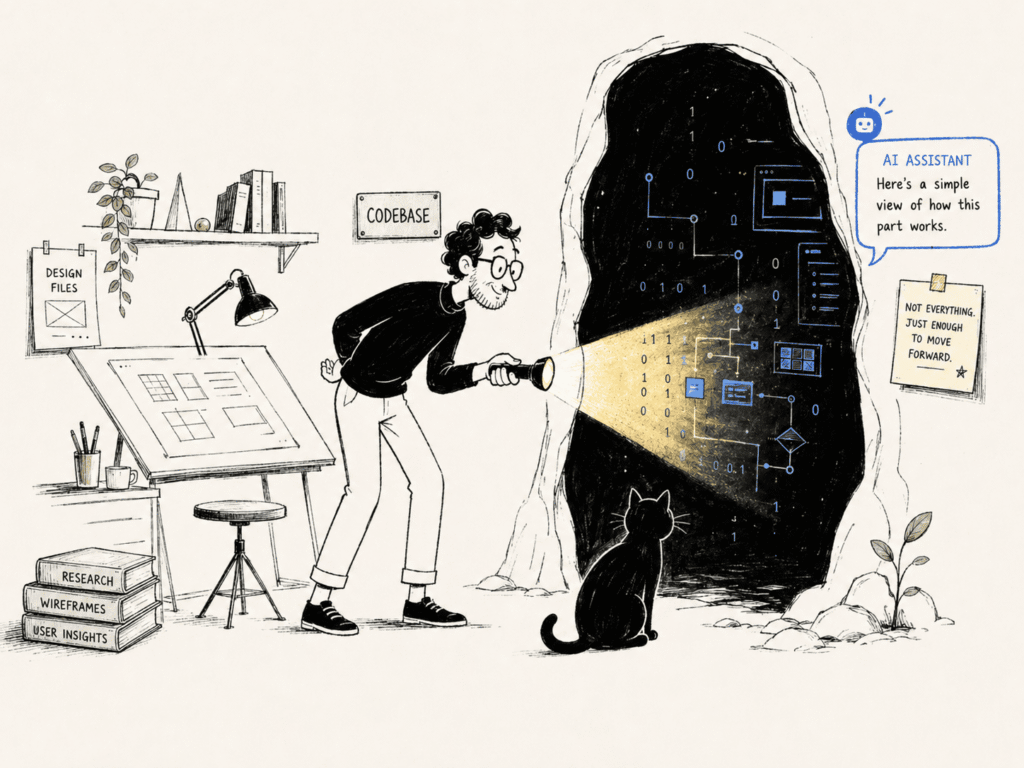
The threat to experienced people isn’t losing jobs. It’s losing curiosity.
For beginners, the fear is: Am I too late?
For experienced people, the fear is: Did I spend years becoming good at something that is losing value?
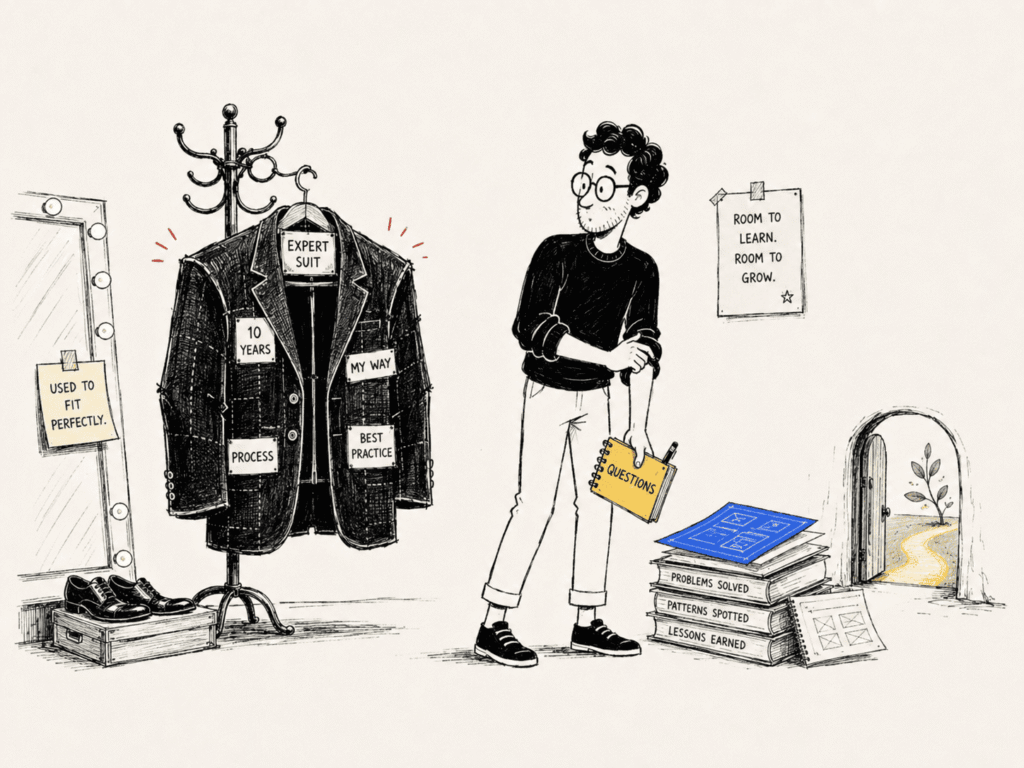
That fear is understandable. When you spend ten years building an identity around a craft, disruption feels personal. It is not only about income. It is about dignity. Relevance. The uncomfortable possibility that the habits that once made you valuable may now make you slow.
But experience is not useless. Unexamined experience is.
Ten years of experience matters if those years built judgment, taste, pattern recognition, communication, user empathy, and the ability to make strong decisions under messy conditions. It matters if it made you better at seeing what others miss.
But if those ten years only taught you one workflow, one tool, one process, or one way of being useful, then the discomfort is real. AI will expose that.
This is not an insult. It is an invitation.
The senior designer does not need to become a beginner again in status. But they do need beginner’s curiosity again.
That is harder than it sounds. It means asking basic questions without feeling embarrassed. It means opening code without pretending to understand it. It means using AI tools without making them your identity. It means watching younger people move faster without becoming defensive. It means letting go of the old prestige of knowing and returning to the raw energy of learning.
That is where seniority becomes powerful again. Not as authority over others. As depth plus adaptability.
The threat to beginners is skipping judgment to chase output.
A beginner has the opposite burden. They are not protecting ten years of identity. They are trying to build their first one.
The danger for them is skipping the boring parts because AI makes the output look easy.
Why copy screens? Why study spacing? Why learn typography? Why build small interactions? Why struggle with hierarchy when a tool can generate something decent?
Because the screen is not the lesson.
The decision is the lesson.
When you recreate a good interface manually, you are not only moving rectangles. You are forcing your eyes to notice. Why is this text smaller? Why is this button placed here? Why is this section quiet? Why does this layout breathe? Why does this page feel trustworthy?
That is how taste forms.
Copying is not the problem. Mindless copying is.
Every serious craft has a copying phase. Musicians play other people’s compositions. Writers study sentences. Painters copy masters. Designers recreate interfaces.
The point is not to stay there. The point is to understand why something works deeply enough that you can later remix it, question it, and eventually make your own decisions.
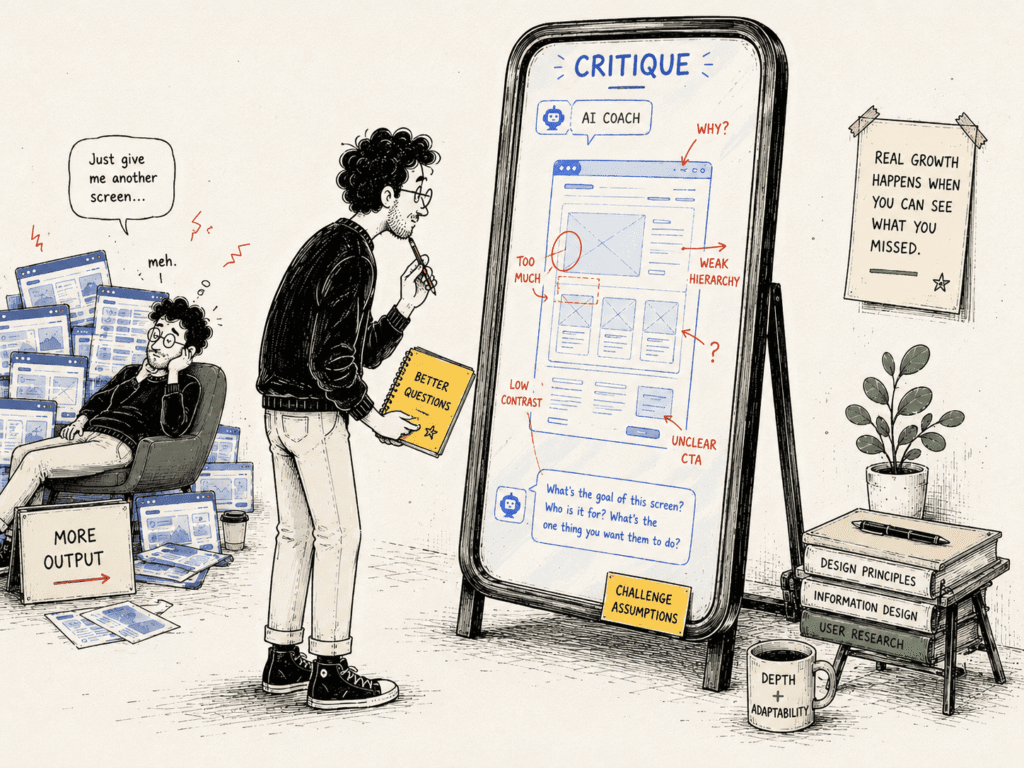
AI can accelerate this learning if used well. Take a screenshot. Ask for a critique. Ask why the hierarchy works. Ask what the designer may have been thinking. Ask what could be improved. Ask how a designer at Anthropic, OpenAI, Linear, Apple, or another high-craft team might approach the same problem.
Not because the answer will be perfect. Because it gives your mind something to wrestle with.
That is the learning loop: do the work, question the work, get feedback, improve the work, repeat.
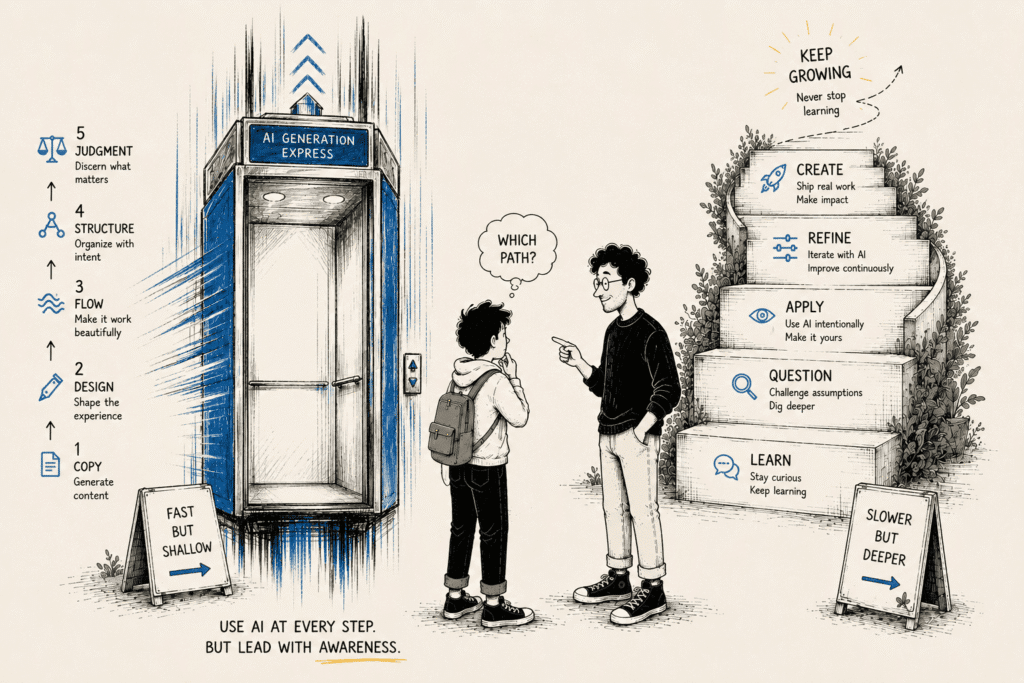
You have access to coaching that was once only for the elite.
One of the most underrated shifts of this moment is not that AI can produce things. It is that AI can teach.
A kind of coaching that was once available only to people with money, access, or proximity is now available to anyone curious enough to ask better questions.
You can ask it to review your design like a harsh design director. You can ask it to explain backend logic like you are a designer. You can ask it to compare your solution with how a top product team might think. You can ask it to show what you are missing. You can ask it to challenge your assumptions.
Knowledge is now only a few prompts away.
But there is a catch.
Easy access does not mean easy understanding.
The internet already taught us this. Information became abundant, but wisdom did not. Some people used the internet to learn deeply. Others used it to scroll themselves into anxiety.
AI will be the same.
For a focused person, it is a personal coach. For an unfocused person, it is another infinite distraction machine.
So your information diet matters. Use Twitter for signals, not truth. Use YouTube for depth, not background noise. Watch great designers share their screens. Watch how they think, not just what they make. Observe their pauses, their doubts, their tiny decisions, their willingness to undo work.
Use AI to deepen your questions. Use real work to test your understanding.
Signals tell you what is changing. Depth tells you why it matters. Work tells you whether you actually understood.
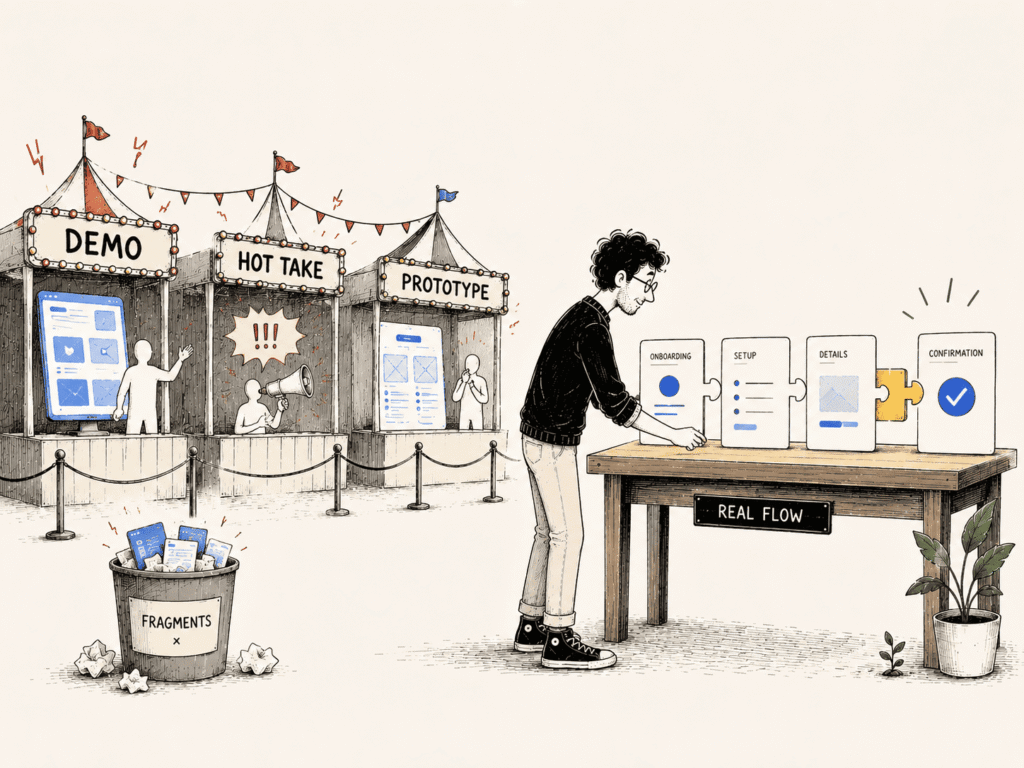
Demos don’t prove anything. completion does.
AI has made it very easy to look busy. You can generate a concept, post a thread, make a prototype, publish a hot take, and appear ahead of the curve.
But appearing ahead is not the same as moving forward.
A lot of the current AI culture rewards show-off work: fast demos, half-built ideas, big claims, surface polish, screenshots without consequences. That world is seductive because it gives quick validation. But it does not build much strength.
The better rule is simple:
Completion over show-off.
Finish real things. Finish the case study. Finish the prototype. Finish the redesign. Finish the messy second version. Finish the thing that reveals whether your idea can survive beyond the first impression.
Completion teaches what performance cannot. It teaches scope, tradeoffs, patience, and where your thinking was shallow. It teaches the difference between a nice direction and a working solution.
In the AI era, the person who can complete meaningful work will stand out more than the person who can produce impressive fragments.
Don’t collect tools. Build range.
Don’t collect opinions. Build judgment.
Don’t collect screenshots. Finish work.
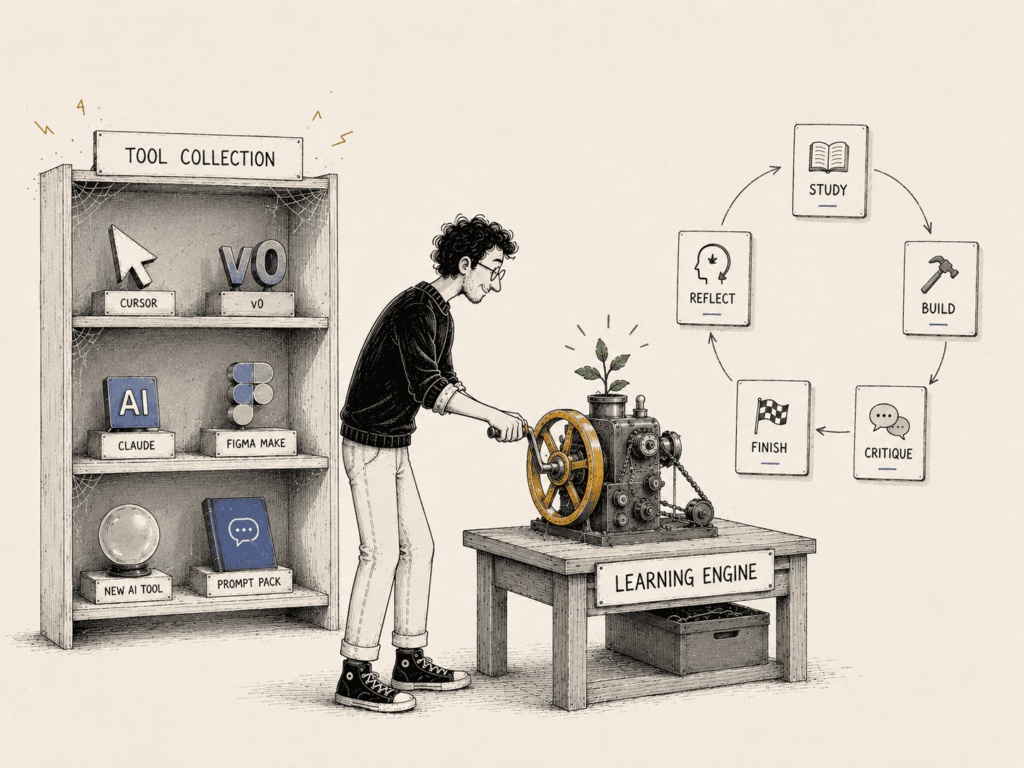
Your real advantage: a learning engine, not a tool collection.
Tools will change until they hit some threshold of maturity. Nobody knows when that happens.
Today it is Cursor, Claude, Lovable, v0, Figma Make, or some new product. Tomorrow something else will arrive with a better demo and a louder launch.
Learn tools, but do not worship them.
Your real job is to build a learning engine inside yourself.
A learning engine is not complicated. Stay close to the work. Ask basic questions. Use AI to unblock yourself. Study people who are better than you. Benchmark the best teams. Copy with intention. Build your own version. Ask for critique. Finish the work. Reflect on what changed. Repeat.
This sounds simple because the truth usually is. But simple is not easy.
The difficult part is emotional.
Can you keep working when someone online says your role is dead? Can you learn a new tool without making it your personality? Can you admit you don’t know something after being experienced for years? Can you go slowly when everyone else is rushing to post? Can you remain a beginner without feeling small?
That is the real test.
Calm people will win
I don’t know exactly how design jobs will look five years from now. I don’t think anyone does.
But I have a strong feeling about the kind of person who will remain useful.
It is the person who can stay close to humans while becoming fluent with machines. The person who can build, but also judge. The person who can learn fast, but think slowly. The person who can use AI without outsourcing their taste. The person who can hear the noise, take the signal, and return to the work.
That is why I keep coming back to stillness.
Stillness is not a soft trait anymore. It is operational strength. It is how you avoid panic decisions, protect your attention, keep learning when your identity feels threatened, and keep doing the work when everyone else is performing certainty.
The future will keep changing its tools. That part is outside your control.
What you can build is harder to replace: a calm mind, sharp taste, deep curiosity, and the discipline to finish real work.
In a noisy world, stillness is not weakness.
It may be the only way to think clearly.
Leave a Reply